

Feature, Current
History in Bloom
Between flower-filled gardens and two new exhibits, this spring is a great time to take another look at Macculloch Hall Historical Museum.
By Christine Bockelman
Like this article? Share it with your friends!
Especially if you’ve lived in Morristown a while, you might think you know all there is to know about Macculloch Hall, the Gilded Age mansion turned historical museum. Kathleen Bartlett, a Morristown resident who was recently appointed Executive Director, thinks the museum is one of the best-kept secrets in Morristown. “I’d like it to be one of the worst-kept secrets, though,” she says. “I want everyone to come and see all we have to offer.”
Built in 1810 by George and Louisa Macculloch, both European-born Morristown transplants, Macculloch Hall was initially a summer house for the family. Over time and five generations, it was expanded to become a full-time residence.
George Macculloch is best known for having the idea for the Morris Canal, a manmade waterway that ran from the Delaware River to the Hudson River and was used to transport raw materials, like coal. “Boats were put on carriages and pulled along on rails, like railroad track, by cables,” says Ryan Hyman, the museum’s longtime F.M. Kirby Curator of Collections.
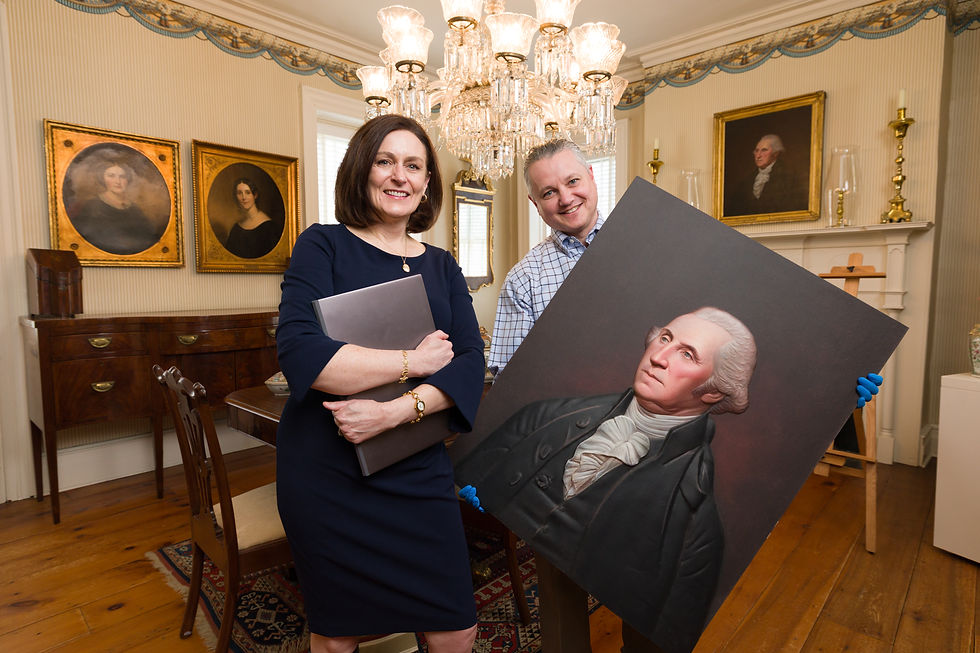
The museum’s exhibit on the canal serves as a good example of how it is working hard to make its collections more accessible and inclusive. Sections of the canal’s rail and thick cable are part of its “Please Touch Tour.” Also included is a three-dimensional copy of the museum’s prized 1795 portrait of George Washington by Charles Willson Peale. The original hangs over the fireplace, but the oversized copy features the raised angles and lines of Washington’s face. It allows visitors, especially the visually impaired, to literally get a feel for the former President’s profile. The museum also offers sensory-friendly tours, which encourage lots of touching and a slower pace.
“The Touch Tour provides a multi-sensory, dynamic way to experience history and art,” says Bartlett. “While it was created for those with vision impairment and those who thrive in a sensory-friendly environment in mind, we’ve found that it has become an important touch point for everyone. Having the opportunity to interact with the objects brings the stories we share to life, and the Touch Tour stations have quickly become a highlight of the museum experience.”
OLD IMAGES, NEW VIEWPOINTS
The museum is best known for having a massive collection, numbering 5,000 images and artifacts, from American political cartoonist and Morristown resident Thomas Nast. For most of his career—from about 1862 to 1877, and again briefly in the late 1890s—Nast worked for “Harper’s Weekly,” during which time he popularized iconic political images like the Democratic party Donkey, Republican party Elephant, and Uncle Sam.
“Back then, there was no television, no radio, no other source of information,” Hyman says. “There was also a low literacy rate, so people were using Nast’s drawings to understand what was happening in the world. They were getting their information from seeing his pictures. It’s not that different than how some people today get their information from social media or YouTube videos.”
Nast’s drawings have a timeless quality, Hyman says. “I’ve had people look at them and say that you could just change out the faces for modern politicians and the messages remain the same,” he says.
CELEBRATING 250 YEARS OF AMERICA
In honor of America’s 250th anniversary this July, Hyman has curated historic artifacts collected by W. Parsons Todd, founder of the Macculloch Hall Historical Museum, who was the great grandnephew of Dolley Madison. Some of her letters are exhibited, along with a letter appointing James Monore ambassador to Great Britain that’s signed by Thomas Jefferson and James Madison, her husband. Letters written by George Washington, including some penned while he was living in Morristown and his handwritten 1789 Thanksgiving Proclamation (one of only five copies known to still exist), are also on display. And, in the center of one of the display cases, there’s a pair of tiny portraits of George and Martha Washington, painted on silver dollar coins, by Revolutionary-era artist John Trumbull.
“Visitors are often surprised to learn that we hold such rare revolutionary artifacts in our collection,” says Bartlett. “These items are on par with objects found in much larger, well-known institutions. The fact that they are located here, in Morristown’s community museum, means that our residents and those in surrounding towns have easier access to important pieces of history—ones they might not have otherwise been able to experience.”
Hyman also curated a never-before-seen selection of Nast images related to American’s founding, digging through the museum’s collection looking for images of George Washington, Uncle Sam, and others. “Looking at these, you can see how much Nast valued Washington as a symbol of what the country should be,” he says.
The exhibit, called “Thomas Nast Celebrates Independence in the United States,” starts with a pencil sketch of Washington that Nast did when he was only about 15 years old. “I wanted to start there, with his beginnings as an artist, and then progress through his political cartoons over the years,” Hyman says. Noteworthy drawings include “Uncle Sam’s Thanksgiving Dinner,” which shows three of Nast’s favorite presidents—Lincoln, Washington, and Grant—along with a melting pot of people from all different countries sitting at the same table.”
The Macculloch Hall Historical Museum is open Thursday, Saturday, and Sunday from 12 to 4 p.m., and on other weekdays by appointment. Call 973-538-2404 or email info@maccullochhall.org to schedule a visit. Learn more at maccullochhall.org.
SIDEBAR
Rooted in History
Visit the gardens at Macculloch Hall in May to enjoy blooming wisteria, peonies, magnolias and, toward the end of the month, roses.
When George and Louisa Macculloch purchased their grand, brick mansion, it came with 26 acres of property. Over the years, the family sold off parcels, and today just about two acres remain. Lucky for us, George kept meticulous records of the fruit trees, kitchen garden, and flowers that existed on the property back then. We know that the wisteria that winds its way along the back porch trellis was given to the family in 1857 by Commodore Matthew Perry, that the sundial on the upper lawn was installed in 1876, and the sassafras tree on the edge of the lawn is among the largest and oldest in New Jersey. We also know that Louisa paid just one dollar to have the first roses planted on the property in 1810.
In the 1950s, the Garden Club of Morristown was asked to replant the Macculloch gardens. They designed a seasonal bloom. In early May, expect historic wisteria, peonies, and magnolias to be in bloom. By the end of the month, the rosebushes should start flowering.
“The garden is a lesser-known hidden oasis in the heart of Morristown that comes alive in spring and continues to bloom throughout the season,” says Kathleen Bartlett, executive director of Macculloch Hall Historical Museum. “We invite everyone to visit us and to take a minute out of the day to rest and recharge.”
While the gardens are free and open daily from 8 a.m. to dusk, the museum’s National Public Gardens Day celebration (May 9 from 10 a.m. to 1 p.m.) is a particularly great time to drop in. The event will include a visit from some puppies from The Seeing Eye, gardening demonstrations by an expert with the Rutgers Master Gardner Program, a watercolor activity inspired by the wisteria, hands-on vegetable bed planting, and more.